

Mental Health and Wellbeing
Statement of mental health and pastoral intent
Moral purpose
Milton Park Primary School Pastoral Team is passionate about making a difference to the lives of children and young people. We believe in teamwork; working with each other, with teachers and colleagues across the school, with the wider school community and most importantly with the children in our school. We act with determination. Whatever issues our students, their families, the school, our team or the community face, we always support, react and pull together. Finally, we are committed to making a difference; we are not passive players in young people’s lives but active participants who can and do make a real difference. These are a reflection of the school’s core values, in that we all are respectful, responsible and resilient.
What inclusion and effective mental health interventions means to us
- The child stays at the centre of every conversation.
- We prioritise those who need our help most, but we intervene with all.
- When young people are here, we can support and educate them – attendance matters.
- Young people learn best when there are clear rules and simple consequences.
- Staff teach best when there are clear rules and simple consequences.
- We use evidence-based practice for all our interventions.
Expectations of ourselves as staff members
- Our notes and records are recorded in a timely manner kept up to date.
- We all will have read and understood section one of Keeping Children Safe in Education 2021.
- We will make sure we know our behaviour, SEMH, attendance and safeguarding policies and protocols.
- We will always attend duties to support the wider school community.
- We will attend meetings on time and prepared.
- We will ensure pastoral work is evidenced and purposeful.
- We will always speak to students, staff and each other with courtesy, respect and understanding.
Safeguarding
- Safeguarding students comes above everything else we do.
- All staff across the school have training annually with reminders throughout the year at briefings, staff meetings and inset days.
- All new staff have safeguarding training as part of their induction.
- All staff at the school recognise that safeguarding is everyone’s responsibility, that they should have read and understood section one of Keeping Children Safe in Education 2021, that early intervention is key and that context matters.
- All records are kept securely.
- The Pastoral Care and Mental Health Lead is an experienced and trained practitioner.
Attendance
- All staff have a role to play in ensuring each child attends school.
- The Pastoral Lead has overriding responsibility to monitor and check on whole school attendance and to support children whose attendance is low to find ways to improve this in consultation with parents/carers and children.
- All of the Pastoral Team work to remove barriers to good school attendance.
- We work together with external agencies to address and remove barriers to school attendance.
- We prioritise students who are classed as disadvantaged, SEMH or SEN, however, we are passionate about providing the same support to all students, irrespective of background.
- We follow the protocols which are in place, acknowledging that each child and situation is different and adjusting as required.
Behaviour
- Good behaviour allows for teachers to teach and students to learn.
- We have a moral obligation to prepare young people for the rigours of work and life beyond education.
- We are here to educate the whole child, helping with their moral and personal development.
- We apply the policies for each student, acknowledging that each child and situation is different and adjusting as required.
- We prioritise students who are classed as disadvantaged, SEMH or SEN, however, we are passionate about providing the same support to all students, irrespective of background.
- We make reasonable adjustments for students with special educational needs or vulnerable students.
- We have a restorative based behaviour system which allows children to respond to incidents of poor behaviour by showing improved behaviour.
- We involve parents in supporting their child to improve their behaviour.
Pastoral care/mental health
- Pastoral support is driven by our desire to ensure each child achieves the best outcomes possible during their time at school.
- We do not give up on students and constantly look for ways to support them.
- Our interventions are directed by evidence-based practice.
- Our Pastoral Team are passionate about being the best they can be when supporting children and families with pastoral and mental health support.
- We work with numerous external agencies to support our students.
- We recognise that early intervention is vital.
- We involve parents as appropriate in the support which we put in place.
- The mental health of our students and staff is of the highest priority.
We believe that paying more attention to the present moment – to your own thoughts and feelings, and to the world around you.
This can improve your mental wellbeing. This awareness is known as "mindfulness".
Why is 'mindfulness' important ?
Mindfulness can help us to enjoy life more and understand ourselves better. It is proven to improve a child's ability to focus and can be a great help in times of stress when used as a way to calm down.We believe well being is all about our holistic health including physical and emotional.
At Milton Park, we are committed to supporting the health and wellbeing of our pupils and staff to ensure that the school is a community where everyone feels able to thrive. Positive mental wellbeing is essential if children and young people are to flourish and lead fulfilling lives.
At our school, we know that everyone experiences life challenges that can make us vulnerable and at times anyone may need additional emotional support. We take the view that positive mental health is everybody’s business and that we all have a role to play.
What does research say ?
Over 50% of mental illnesses start before the age of 14 and 1 in 10 children and young people has a mental health disorder (Public Mental Health, 2014). Recent survey results found that 12.5% (one in eight) of 5 to 19 year olds, surveyed in England in 2017, had a mental disorder (NHS, 2017).
“Mental health is a state of well-being in which every individual realises his or her own potential, can cope with the normal stresses of life, can work productively and fruitfully, and is able to make a contribution to her or his community,” (World Health Organization, 2014).
What do 'mindfulness' lessons look like ?
Two key elements to support good mental health are:
- Feeling Good – experiencing positive emotions like happiness, contentment and enjoyment. Including feelings like curiosity, engagement and safety.
- Functioning Well – how a person is able to function in the world, this includes positive relationships and social connections, as well as feeling in control of your life and having a sense of purpose.
Our role in school is to ensure that children are able to manage times of change and stress, and that they are supported to reach their potential or access help when they need it. Children are taught when to seek help, what help is available, and the likely outcome of seeking support so that they have the confidence and knowledge for themselves or others. We also have a role to ensure that children learn about what they can do to maintain positive mental health, what affects their mental health and how they can help reduce the stigma surrounding mental health issues. As part of our targeted provision, we have and continue to access, outside help and support for pupils when required.
At Milton Park , we believe that teaching about mental health and emotional wellbeing as part of a comprehensive PSHE and Emotional Literacy curriculum is vital. PSHE and Emotional Literacy are central to the curriculum across the whole school and assists pupils to cope with the changes at puberty, introduces them to a wider world, manage transitions and enables them to make an active contribution to their communities. The concepts covered in PSHE include keeping safe and managing risk, identity, equality, managing feelings and emotions, relationships, change, resilience and being healthy, which includes physical, mental, emotional and social well-being. We aim to promote pupils’ wellbeing through an understanding of their own and others’ emotions and the development of healthy coping strategies.
We include World Mental Health Day and Mental Health Awareness Week in the school calendar and plan activities for the whole school.
Levels of support
- Universal Support– To meet the needs of all our pupils through our overall ethos, school values and our wider curriculum. For instance, developing resilience, respect and responsibility all.
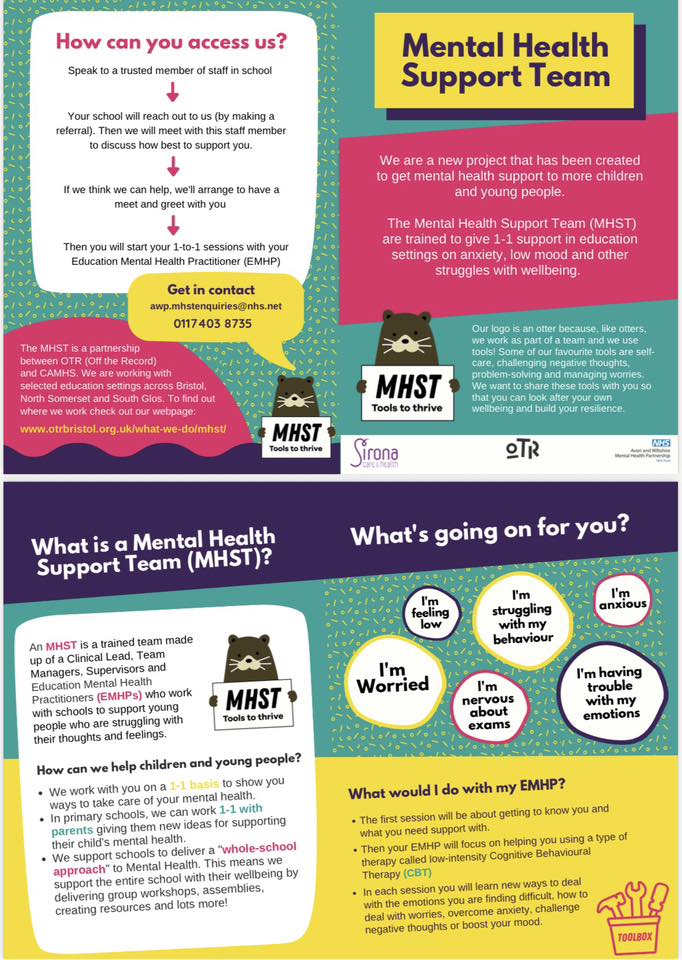
- Additional support– For those who may have short term needs and those who may have been made vulnerable by life experiences such as separation or bereavement. Our pastoral team are very skilled and trained in providing targeted interventions for individuals.
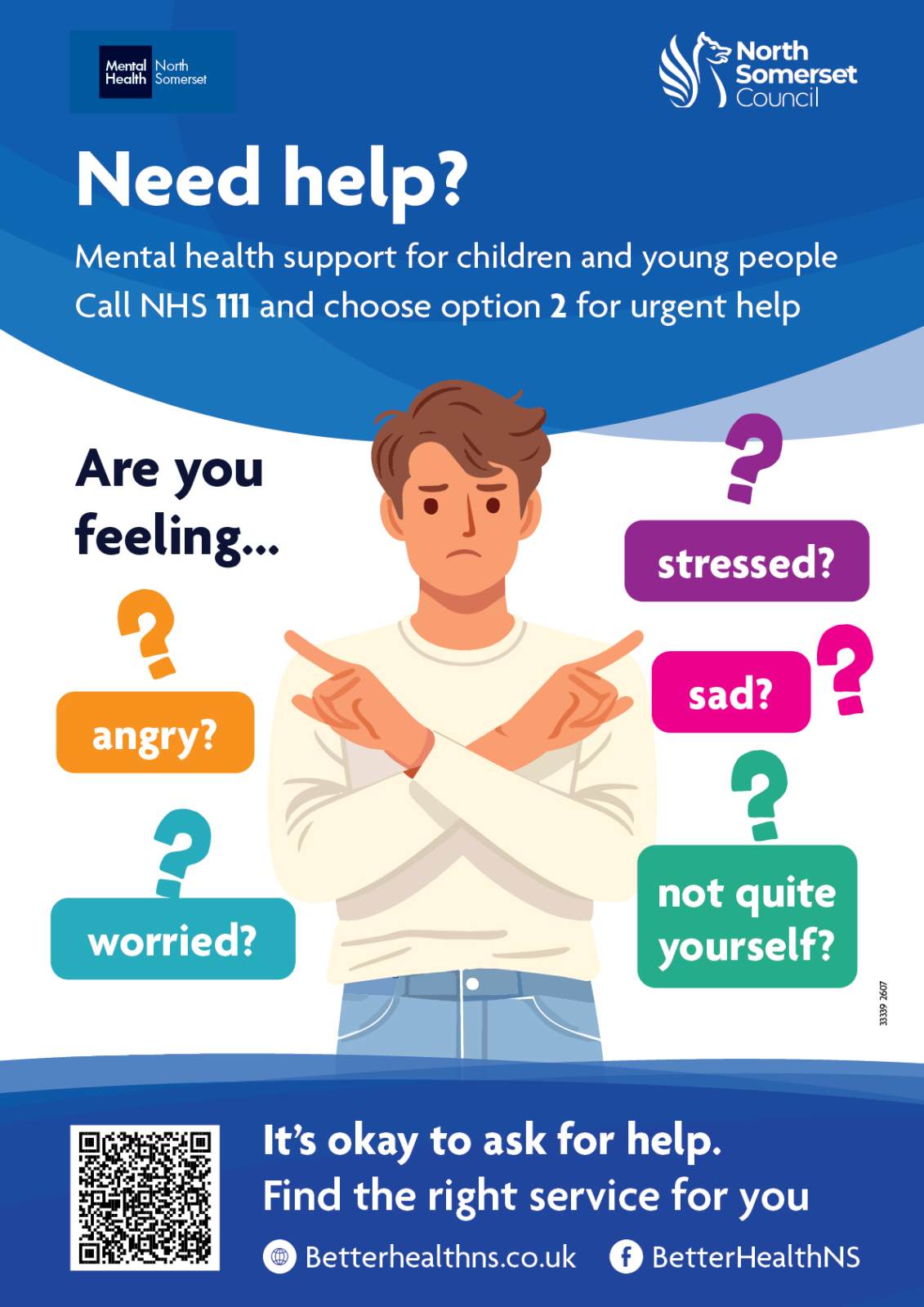
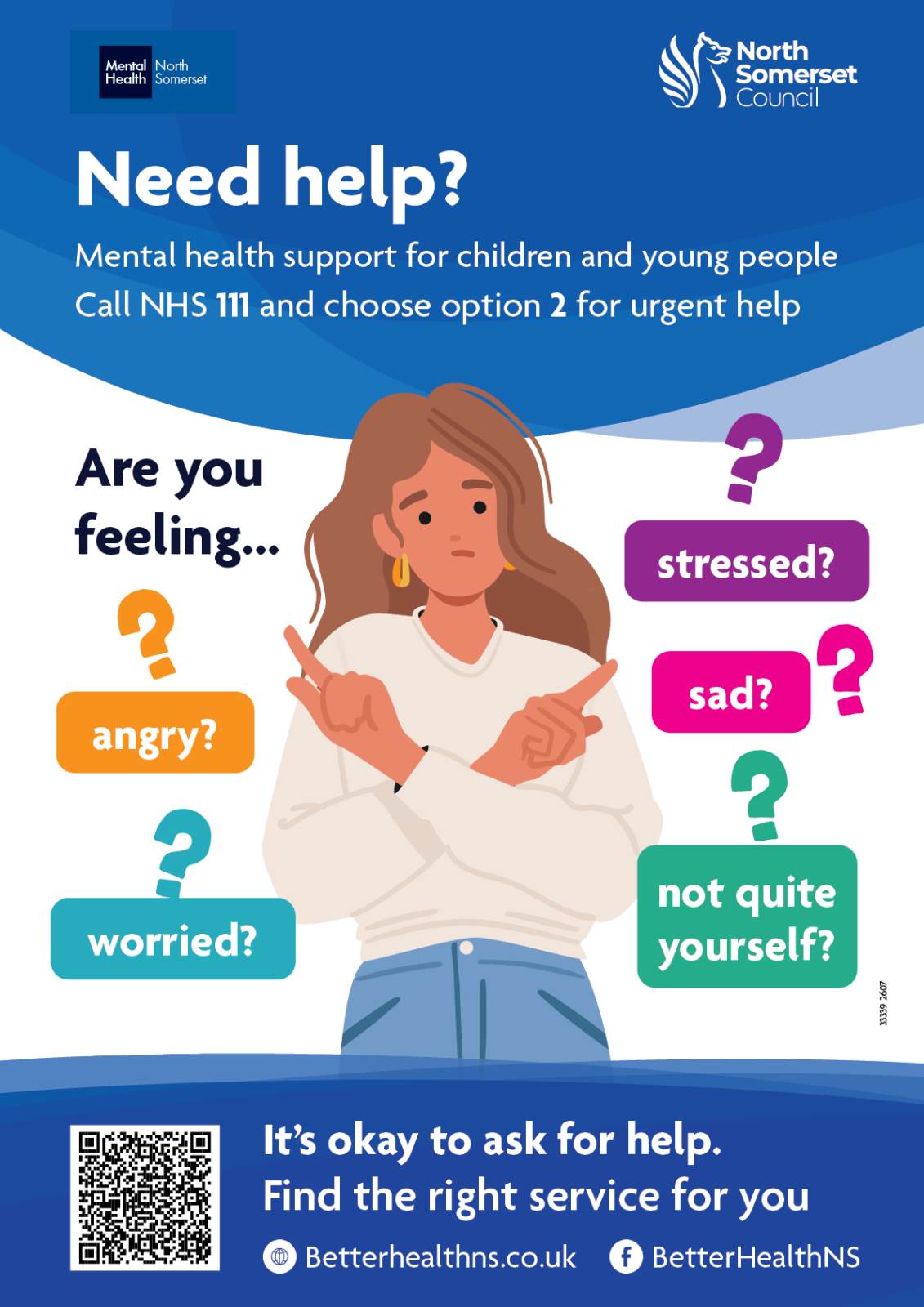
- Targeted support– For pupils who need more specialists support and resources referral to wider professionals is available.
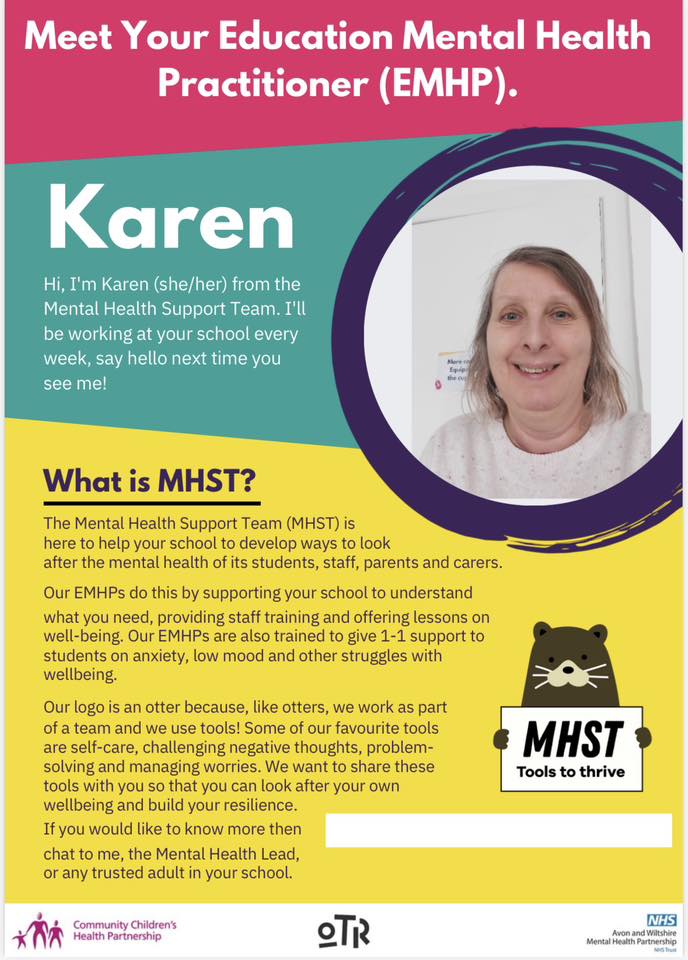
- Referrals can be made to the mental health practitioner.
Useful contacts
- Milton Park Primary School main school office : 01934 624868
- If you have any concerns about the behaviour of someone working or volunteering with children please contact LADO - Local Authority Designated Officer via the Referral and Assessment Team : 01275 888808 or email lado@n-somerset.gov.uk
- Single Point of Access/ Children's Front Door on 01275 888808 or childrens.frontdoor@n-somerset.gov.uk
- Out of hours social care Emergency Duty team: 01454 615165
- Childline: 0800 1111 https://www.childline.org.uk/
- Samaritans: 116123 https://www.samaritans.org/
- Next Link: Domestic Violence Hotline: 08082000247 https://www.nextlinkhousing.co.uk/northsomerset/
- Young Minds (resource for young person's mental health): 0300 1233393 https://youngminds.org.uk/
- Kooth (resource for young person's mental health) https://www.kooth.com/
- Action for Children: 0300 123 2112 ask.us@actionforchildren.org.uk
- NSPCC: 0808 800 5000 help@nspcc.org.uk
- Young Victims (help and support to young people (aged five to 18) who have been victims of crime, anti-social behaviour or domestic abuse) https://www.youngvictims.org.uk/
-
Should you need to be signposted to any other agency, please contact school directly.
Here are a few links to other organisations that may be able to support you
Young people support, guidance and advice on a wide range of online safety issues and topics
Anna Freud is a world-leading mental health charity for children and families